
| Point | Details |
|---|---|
| Service | Healthcare AEO & GEO Services |
| Best For | Doctors, clinics, hospitals, healthcare brands |
| Main Goal | Visibility in AI search and answer engines |
| Platforms Considered | Google AI Overviews, ChatGPT, Perplexity, Gemini, Bing Copilot |
| Core Work | Entity SEO, schema, content structuring, topical authority, E-E-A-T |
| Related Services | Healthcare SEO, healthcare content, website development, reputation management |
| Outcome | Better discoverability, clearer expertise signals, stronger online trust |
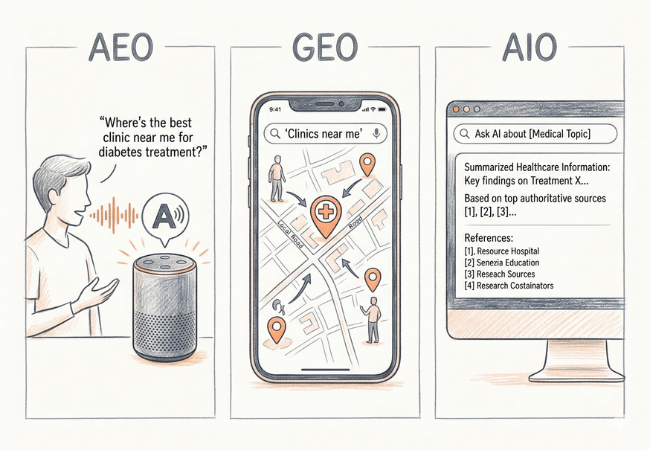
Earlier, patients searched Google, clicked multiple websites, and compared doctors or hospitals manually.
Now, many patients ask questions like:
Search engines and AI platforms are trying to answer these questions directly. They rely on websites that are clear, structured, credible, and easy to understand.
For healthcare brands, this means your website should not only rank. It should also be understood, trusted, and cited by answer engines.
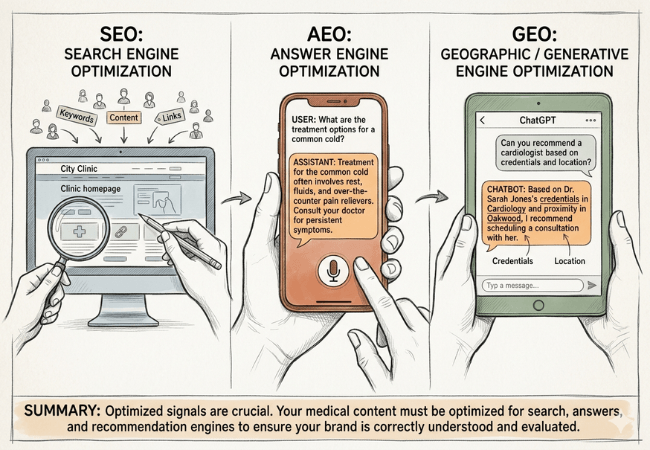
AEO stands for Answer Engine Optimization.
It focuses on making your website content clear, direct, and answer-friendly so that Google, AI Overviews, featured snippets, and voice search can extract useful answers from your pages.
GEO stands for Generative Engine Optimization.
It focuses on improving how AI platforms such as ChatGPT, Perplexity, Gemini, Claude, and Bing Copilot understand your brand, services, doctors, locations, and expertise.
For healthcare websites, AEO and GEO are not separate from SEO. They work together.
SEO helps you rank.
AEO helps you answer.
GEO helps AI systems understand and recommend you.
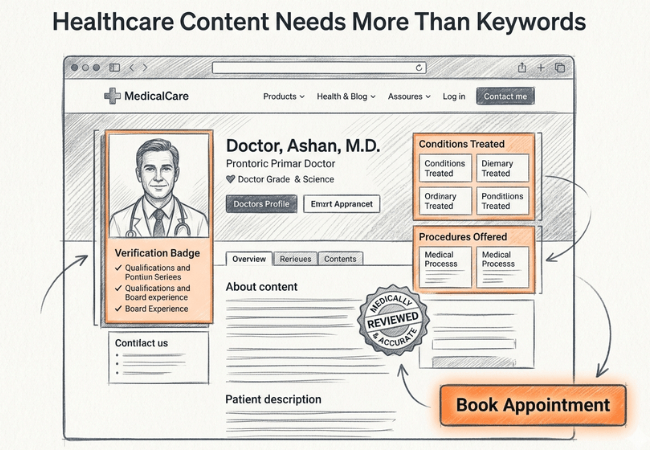
In healthcare, people are not searching casually. They may be anxious, confused, or looking for the right doctor for a serious condition.
That is why healthcare AEO and GEO require more than regular SEO tactics.
Your website must clearly show:
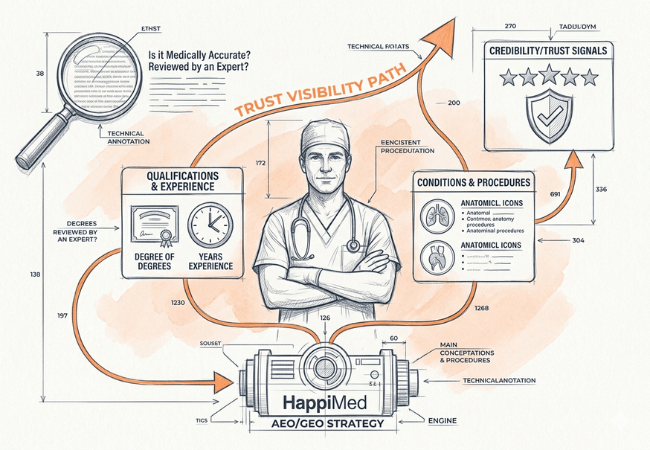
HappiMed builds AEO and GEO strategy around these healthcare-specific trust factors.

These may include:
Doctor, Clinic, Hospital, Medical specialty, Treatments, Procedures, Conditions, Locations, Departments, Technology, Patient education topics, Appointment and contact points, Reviews and reputation assets.
This helps search engines and AI tools understand who you are, what you do, where you operate, and why you are relevant.

For example, a surgical oncologist’s website may need pages for:
Surgical oncology, Cancer types treated, Cancer surgery procedures, Robotic surgery, Laparoscopic surgery, Second opinion, Recovery guidance, FAQs for patients
This structure helps AI systems see depth, not just isolated pages.

These may include:
Quick Answer sections, At a Glance tables, Who is this for?, Treatment summary blocks, Cost explanation blocks, Recovery timeline blocks, FAQs, Comparison tables, Doctor expertise summaries, Patient decision guides
These blocks make your content easier to extract, summarize, and cite.

Depending on the page, this may include schema for:
MedicalClinic, Hospital, Physician, MedicalWebPage, MedicalProcedure, MedicalCondition, MedicalTherapy, Service, FAQPage, BreadcrumbList, LocalBusiness, Organization, WebSite, ContactPoint
We also use connected @id relationships wherever appropriate so that different parts of your website form a stronger semantic network.

We help improve:
Doctor profile depth, Credentials and qualifications, Experience signals, Reviewed by sections, Clinic or hospital credibility, Treatment expertise, Patient education quality, Real-world experience indicators, Testimonials and reviews, Media, video, and publication signals, Clear contact and appointment information.
This helps both patients and search systems trust your brand.

We help organize your website using:
Service hub pages, Condition hub pages, Treatment pages, Procedure pages, Doctor profile pages, Location pages, FAQ pages, Educational blogs, Internal linking, Breadcrumbs, Clear parent-child URL structure.
This helps AI systems understand the relationship between your pages.

We help strengthen your reputation footprint through:
Google Business Profile optimization, Review strategy, Review response support, Consistent doctor and clinic information, Directory profile improvement, Local healthcare visibility, Patient trust signals.
For healthcare, reputation is not optional. It directly affects patient confidence.

We improve existing pages by adding:
Clear answers, Better headings, medically accurate explanations, expert-led insights, FAQs, tables, semantic internal links, schema alignment, patient decision support content.
The goal is to make each important page more useful to patients and more understandable to AI systems.
| Area | What We Improve |
|---|---|
| Website Structure | Hub pages, service pages, treatment pages, internal linking |
| Content | Answer blocks, patient-friendly explanations, FAQs, comparison sections |
| Schema | Medical, local, service, doctor, FAQ, breadcrumb, and entity schema |
| Doctor Authority | Credentials, experience, reviewed by sections, expertise signals |
| Local Visibility | Google Business Profile, location relevance, reviews |
| AI Readability | Clear definitions, summaries, tables, entity-rich content |
| Topical Depth | Condition clusters, treatment clusters, procedure clusters |
| Trust Signals | Testimonials, media, videos, case-based experience, reputation markers |

Examples: Surgical oncologists, Bariatric surgeons, Dermatologists, Fertility specialists, Orthopedic surgeons, General surgeons, ENT surgeons, Dental specialists, Hair transplant surgeons.

Examples: Dermatology clinics, Hair transplant clinics, Fertility clinics, Orthopedic clinics, Dental clinics, Eye clinics, Obesity clinics, Physiotherapy clinics, Surgical Centers, Diagnostic centers.






| Strength | How It Helps |
|---|---|
| Healthcare-only focus | We understand doctors, clinics, hospitals, and patient decision journeys |
| SEO + AEO + GEO thinking | We structure content for Google search and AI answer engines |
| Schema experience | We build medical and entity-based structured data carefully |
| Patient-friendly content | We simplify healthcare topics without diluting credibility |
| Local search understanding | We align website content with Google Business Profile and location intent |
| Conversion focus | We guide patients toward calls, WhatsApp, appointments, and enquiries |
| Long-term authority building | We help healthcare brands become trusted knowledge sources |
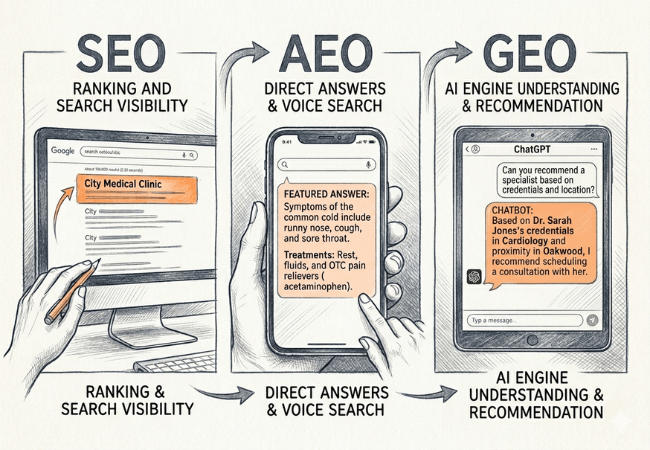
| Term | Meaning | Healthcare Role |
|---|---|---|
| SEO | Search Engine Optimization | Helps your website ranl on Google and other search engines |
| AEO | Answer Engine Optimization | Helps your content answer patient questions clearly |
| GEO | Generative Engine Optimization | Helps AI platforms understand, summarize, and mention your brand |
For a healthcare brand, all three are important.
That is why HappiMed builds SEO, AEO, and GEO together.
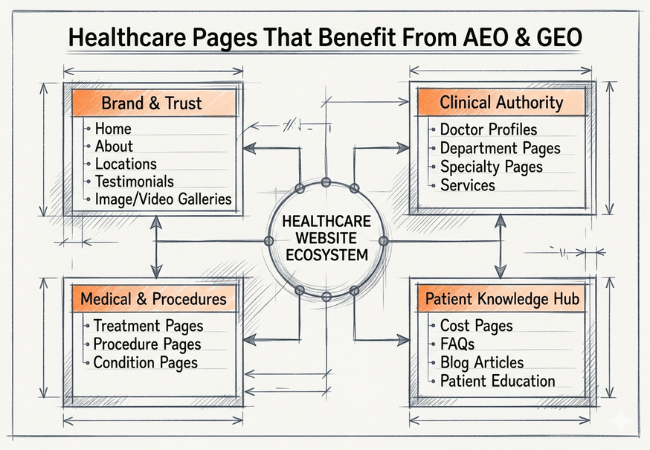
We optimize pages such as:
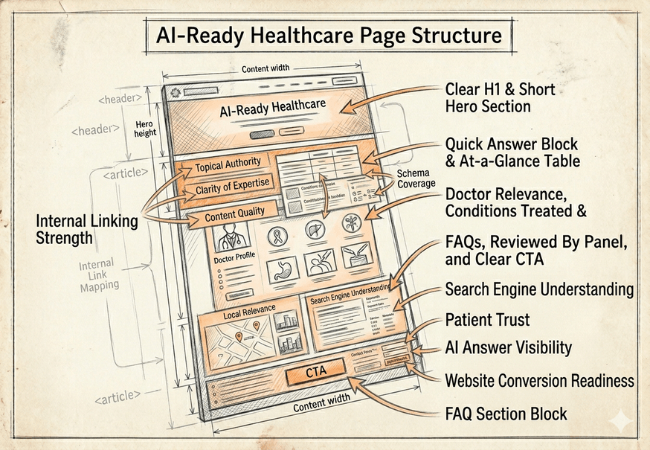
A strong healthcare page should include:
This structure helps both humans and machines.
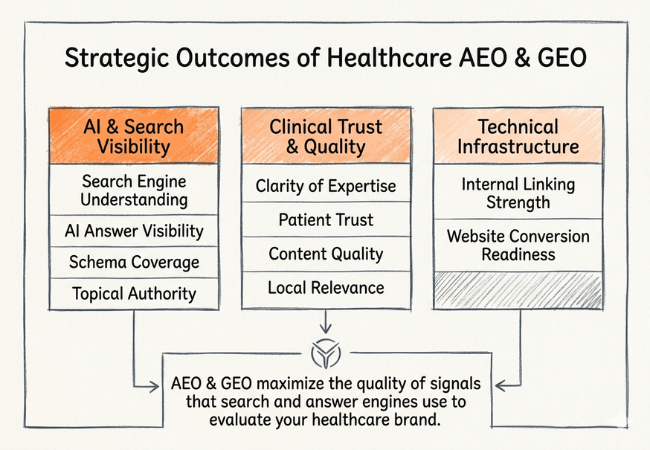
With a structured AEO and GEO strategy, your healthcare brand can improve:
AEO and GEO do not guarantee instant mentions in AI platforms. But they improve the quality of signals that search engines and answer engines use to understand and evaluate your brand.
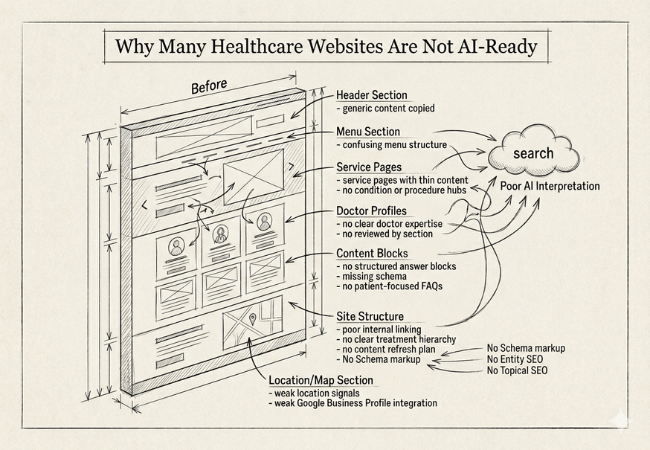
Common problems include:
These gaps make it harder for Google and AI platforms to understand the website properly.
Patients are already using AI to understand symptoms, compare treatments, and choose healthcare providers. Your website should be ready for this shift.
HappiMed can help you build a stronger healthcare digital presence with SEO, AEO, GEO, content, schema, website architecture, and trust-building strategies.
Whether you are a doctor, clinic, hospital, or healthcare business, we can help you create a website that is easier for patients to trust and easier for search engines and AI platforms to understand.
Healthcare AEO means optimizing healthcare website content so that answer engines can easily understand and extract clear answers from it. It helps doctors, clinics, and hospitals answer patient questions more effectively through search and AI-driven platforms.
Healthcare GEO, or Generative Engine Optimization, means improving how AI platforms understand your healthcare brand, doctors, services, treatments, locations, and expertise. It helps your website become more suitable for AI-generated answers and summaries.
Yes. SEO focuses on ranking in search results. AEO focuses on answering questions clearly. GEO focuses on helping AI platforms understand and use your information. For healthcare websites, all three should work together.
AEO and GEO can improve the quality of signals that Google may use for AI Overviews. This includes clear content, strong structure, schema, E-E-A-T signals, and topical authority. However, no agency can guarantee inclusion in AI Overviews.
GEO can improve how clearly your clinic is represented online, but AI platform recommendations depend on many factors. These may include website quality, authority, online mentions, reviews, structured data, topical relevance, and publicly available trust signals.
Schema helps search engines understand the meaning of your content. For healthcare websites, schema can clarify doctors, clinics, hospitals, services, procedures, conditions, locations, FAQs, and contact points.
Yes, it is strongly recommended. A reviewed by section helps show that the content is connected to a qualified medical expert. This supports trust, quality, and healthcare E-E-A-T.
AEO and GEO are long-term visibility strategies. Some improvements may help quickly with clarity and user experience, but stronger search and AI visibility usually takes consistent work over several months.
Yes. HappiMed can audit your existing website and improve its content, structure, schema, internal linking, E-E-A-T signals, and AI-readiness.
Yes. It is especially useful for specialist doctors who want to build authority around their name, specialty, procedures, and city. It can help search engines and AI platforms better understand their expertise.
Let HappiMed help your healthcare brand become clearer, stronger, and more trustworthy across Google, AI Overviews, ChatGPT, Perplexity, Gemini, and other answer engines.