
| Element | What It Means |
|---|---|
| Primary Goal | Build trust, visibility, and qualified patient enquiries |
| Best For | Doctors, clinics, hospitals, specialty centres, healthcare brands |
| Core Channels | Website, SEO, AEO/GEO, Google Business Profile, YouTube, social media, paid ads, WhatsApp, email, CRM |
| Key Foundation | Patient trust and ethical communication |
| Compliance Areas | Medical ethics, advertising guidelines, consent, data privacy, DPDP Act, HIPAA where applicable |
| Main Output | A clear growth roadmap with measurable marketing actions |
| Success Metrics | Enquiries, appointment bookings, search visibility, patient reviews, content reach, conversion rate, cost per lead, patient retention |
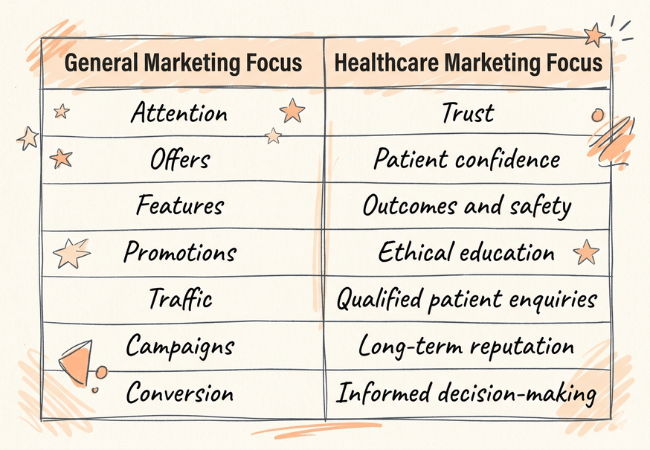
Healthcare marketing is different from general business marketing because patients do not choose healthcare providers casually. Medical decisions are sensitive, emotional, and often urgent. Patients and families look for trust, experience, clarity, safety, convenience, and reassurance.
A person searching for a dermatologist, fertility clinic, cancer surgeon, bariatric surgery center, dental clinic, or multi-specialty hospital is not just comparing prices. They are asking deeper questions:
For doctors, clinics, and hospitals, marketing should not be about aggressive selling. It should be about helping the right patient find the right care at the right time.
That is why healthcare marketing needs a different strategy from general digital marketing.
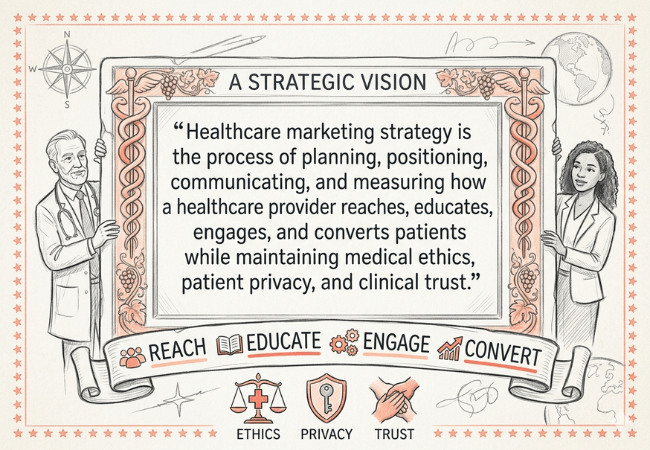
Healthcare marketing strategy is the process of planning, positioning, communicating, and measuring how a healthcare provider reaches, educates, engages, and converts patients while maintaining medical ethics, patient privacy, and clinical trust.
It includes:
A strong strategy connects all these parts into one system.
Without strategy, healthcare marketing becomes scattered. A clinic may post on Instagram, run Google Ads, publish blogs, and ask for reviews, but still fail to generate quality patient enquiries because the activities are not connected.
A good healthcare competition analysis should reveal three things:
Where competitors are more visible.
Where they are building more trust.
Where your practice can create a clearer, more ethical, and more patient-friendly advantage.
| Area to Analyse | What to Check |
|---|---|
| Search Visibility | Keywords, local rankings, “near me” searches, treatment and doctor searches |
| Website Depth | Service pages, doctor profiles, FAQs, CTAs, mobile experience, trust signals |
| Content Authority | Condition pages, treatment guides, cost pages, recovery guides, topic clusters |
| Google Business Profile | Reviews, ratings, photos, services, Q&A, review responses, location accuracy |
| Doctor Positioning | Qualifications, experience, expertise, videos, hospital affiliations, communication style |
| Reputation Signals | Testimonials, awards, media mentions, accreditations, patient stories, third-party profiles |
| Paid Ads | Promoted services, ad messaging, landing pages, CTAs, compliance of claims |
| Social Media & YouTube | Educational videos, reels, FAQs, doctor-led content, consistency, tone |
| Conversion Path | Phone, WhatsApp, appointment form, response speed, location clarity, follow-up process |
Positioning answers one core question:
What should patients remember you for?
For a doctor, this may be expertise in a specialty, a surgical approach, patient-friendly explanation, or years of experience.
For a clinic, it may be focused care for a specific condition, convenient access, advanced technology, or personalized treatment.
For a hospital, it may be multi-specialty care, emergency readiness, surgical expertise, patient safety, or a center of excellence.
Better positioning is specific, credible, and patient-relevant.
A dermatologist may position around acne, pigmentation, anti-ageing, or hair loss.
A fertility clinic may position around ethical fertility guidance, advanced IVF protocols, and emotional support.
A surgical oncologist may position around cancer surgery expertise, robotic surgery, organ preservation, and second opinions.
A hospital may position around advanced surgical care, critical care support, diagnostics, and emergency readiness.
Avoid vague positioning such as:
“Best healthcare provider”
“World-class treatment”
“Affordable care”
“Advanced technology”
These statements are overused. They do not create clear differentiation unless supported by specific proof.
Better positioning is specific, credible, and patient-relevant.
For clinics and hospitals, service-line strategy is critical.
Instead of promoting everything equally, identify:
For example, a multi-specialty hospital may decide to focus marketing on:
Each service line should have its own: Landing page, SEO keyword plan, Google Ads plan, Doctor video plan, FAQ section, Review strategy, Follow-up process.
Not every patient is the right patient.
A clinic or hospital must define the patient segments it wants to attract.
For example, a dermatology clinic may target:
A hospital may target:
Each patient segment has a different intent, concern, budget, decision timeline, and trust requirement.
A strong healthcare marketing strategy creates separate messaging for each segment.

Examples:
“Why am I losing hair?”
“Is breast lump dangerous?”
“Why do I have severe acidity?”
“Is knee pain a sign of arthritis?”
“Why am I gaining weight despite dieting?”
At this stage, the patient needs simple educational content.
Best content types: Blog articles, Short videos, FAQ pages, Symptom explainer pages, Social media awareness posts

Examples:
“GERD treatment in Bangalore”
“Gallbladder stones symptoms”
“PCOS fertility problems”
“Obesity treatment options”
“Hair transplant for male pattern baldness”
At this stage, the patient needs medical clarity, treatment options, and reassurance.
Best content types: Condition pages, Treatment comparison pages, Doctor explainer videos, Patient education guides, Downloadable checklists

Examples:
“Best surgical oncologist in Bangalore”
“Best hair transplant clinic in Bangalore”
“Best fertility clinic near me”
“Best hospital for hernia surgery in Bangalore”
At this stage, the patient needs proof.
Best content types: Doctor profile pages, Service pages, Reviews and testimonials, Before-after galleries, where appropriate and compliant, Case experience, Hospital infrastructure pages, Google Business Profile, YouTube videos

At this stage, friction must be reduced.
Important elements:

This is where many healthcare organisations lose leads.
A good strategy includes:
Your website is the central trust asset of your healthcare marketing.
Social media posts disappear in feeds. Ads stop when budget stops. Google Business Profile depends on platform visibility. But your website remains your controlled knowledge hub.
A healthcare website should not be a digital brochure. It should function as a patient education, trust-building, and conversion platform.
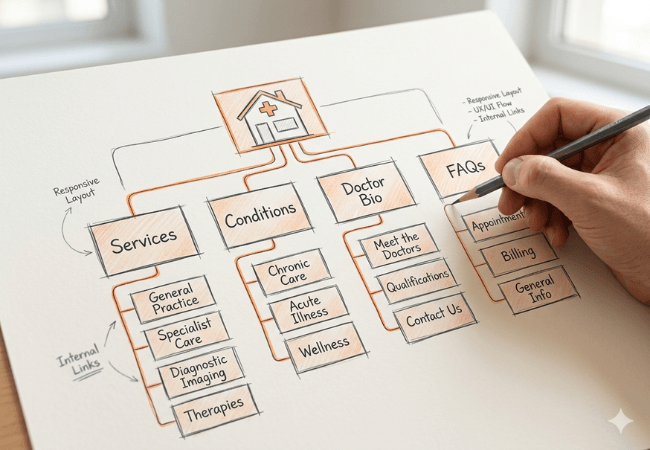
Key Website Elements: Doctor or hospital profile, Service pages, Condition pages, Treatment pages, Procedure pages, FAQs, Patient education , blogs, Videos, Testimonials or patient stories where permitted, Location information, Appointment CTA, Emergency information where relevant, Insurance and payment guidance, Author and reviewer notes, Schema markup, Internal linking, Privacy policy, Consent-aware forms
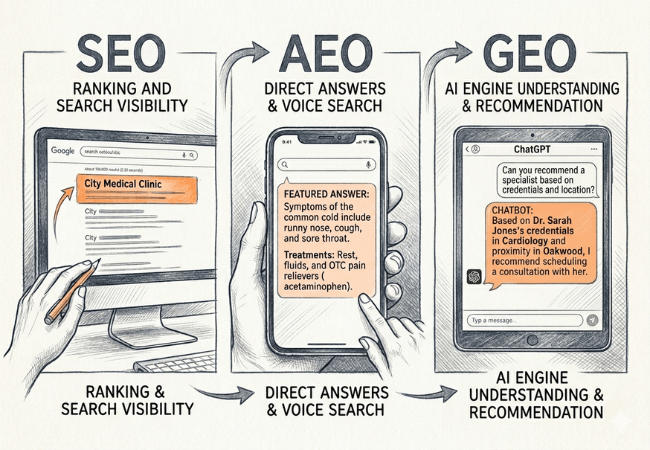
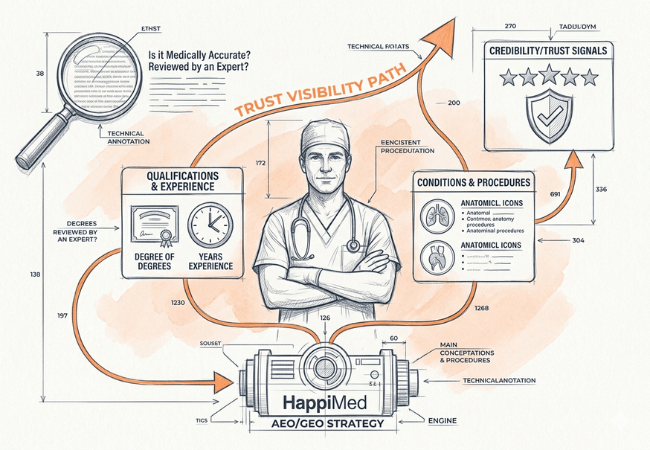
For SEO, AI Overviews, ChatGPT, Perplexity, and other answer engines, the website should be structured as a clear knowledge base.
Healthcare SEO is the process of improving your visibility on Google when patients search for conditions, treatments, doctors, clinics, hospitals, and healthcare services.
But healthcare SEO must be done carefully because medical content can affect health decisions.
Homepage, Service pages, Doctor profile pages, Specialty pages, Condition pages, Treatment pages, Procedure pages, Location pages, Cost pages, FAQs, Blogs, Patient guides, Comparison pages, Recovery guides, Second opinion pages
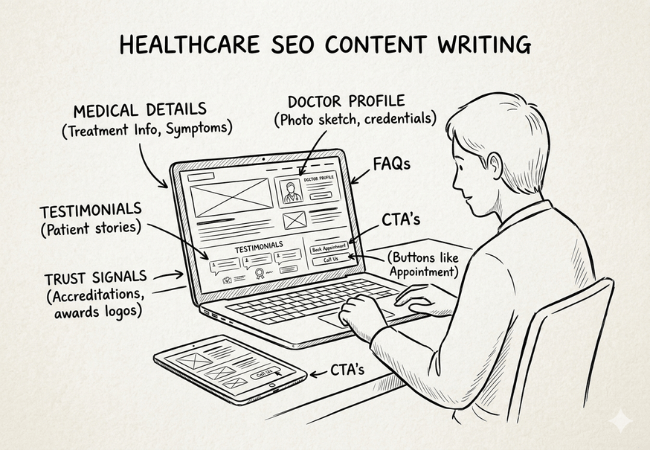
Healthcare SEO usually includes a mix of keyword types:
Condition keywords
“GERD treatment”
“gallbladder stones symptoms”
“hair loss treatment”
Treatment keywords
“PRP hair treatment”
“laparoscopic hernia surgery”
“IVF treatment”
Doctor keywords
“best dermatologist in Bangalore”
“surgical oncologist near me”
Hospital keywords
“best hospital for gallbladder surgery”
“fertility clinic in Bangalore”
Cost keywords
“hair transplant cost in Bangalore”
“hernia surgery cost”
Comparison keywords
“FUE vs FUT hair transplant”
“laparoscopic vs open surgery”
Near-me keywords
“ENT doctor near me”
“skin clinic near Whitefield”
A good healthcare SEO strategy does not chase only high-volume keywords. It builds topical authority around the services and specialties that matter to the practice.
Healthcare search is changing.
Patients no longer rely only on traditional Google search results. They also use:
Google AI Overviews, ChatGPT, Perplexity, Gemini, Voice search, Featured snippets, People Also Ask, AI-powered summaries.
This means healthcare content must be easy for answer engines to understand, extract, and cite.
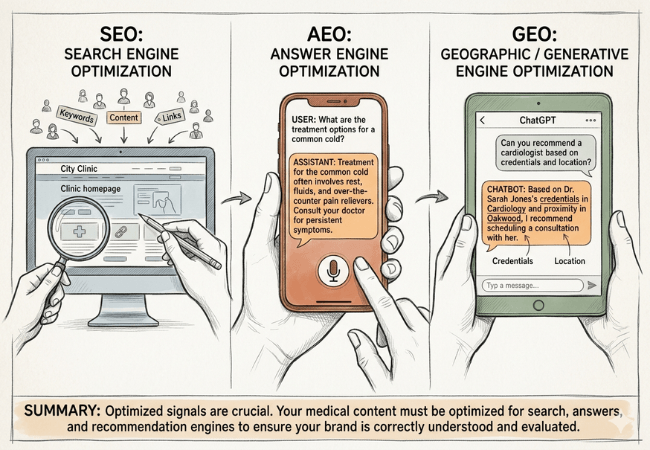
AEO means structuring content so that search engines and AI systems can easily identify direct answers.
Useful AEO formats include: Quick Answer blocks, At-a-glance tables, FAQs, Definition sections, Step-by-step, explanations, Pros and cons, Comparison tables, Eligibility criteria, Treatment timelines, Cost ranges, Safety notes.
GEO focuses on making your content useful and trustworthy enough for AI systems to reference when generating answers.
This requires: Clear entity definitions, Topical depth, Consistent doctor and clinic information, Author and reviewer signals, Schema markup, Cited facts where needed, Original expertise, Structured content, Internal linking, External trust signals, Updated pages.
For healthcare websites, AEO and GEO should not replace SEO. They should strengthen it.
For local healthcare, Google Business Profile is one of the most important digital assets.
Patients often search for:
“doctor near me”
“clinic near me”
“hospital near me”
“dermatologist near Whitefield”
“ENT doctor in Bangalore”
A well-optimized Google Business Profile can influence whether a patient calls, checks directions, reads reviews, or visits the website.
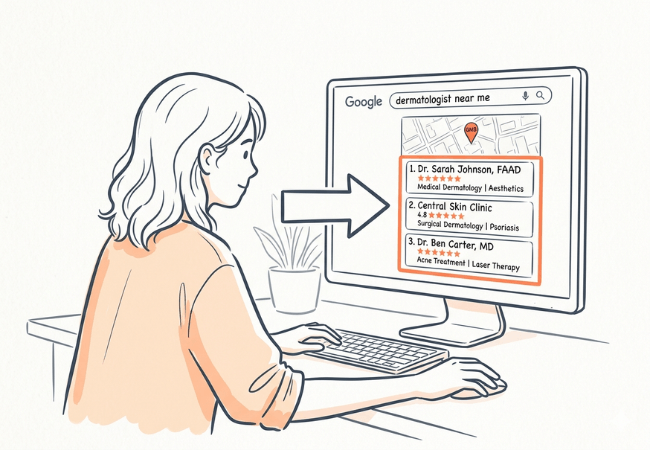
Reviews are not just reputation signals. They are trust signals.
But review collection must be ethical. Patients should never be forced, incentivised, or manipulated into leaving reviews. Negative reviews should be handled calmly, privately, and professionally without disclosing patient information.
Healthcare content should educate before it promotes.
Patients often search online because they are anxious, confused, or trying to understand symptoms and treatment options.
A good content strategy helps them make informed decisions.
Healthcare content should be:
Video is especially powerful in healthcare because patients want to see and hear the doctor.
A well-made doctor video can build more trust than many social media posts.
Video builds familiarity. It helps patients understand the doctor’s communication style, confidence, empathy, and clarity.
For specialties such as dermatology, fertility, oncology, bariatric surgery, gastroenterology, orthopedics, dental care, hair transplant, and cosmetic surgery, video can be a strong trust-building channel.
Healthcare videos should include:
Social media can help healthcare brands stay visible, educate patients, and build familiarity.
But social media should not become the main strategy for every healthcare provider.
For many doctors and hospitals, social media works best as a trust and recall channel, not the only lead generation channel.
Paid ads can help healthcare providers generate faster visibility, especially when SEO is still developing.
Common paid channels include:
Paid ads should not be judged only by number of leads. In healthcare, lead quality, patient fit, consultation conversion, and treatment conversion matter more.
In healthcare, reputation is a growth asset.
Patients look at reviews, ratings, testimonials, doctor profiles, videos, and online mentions before deciding.
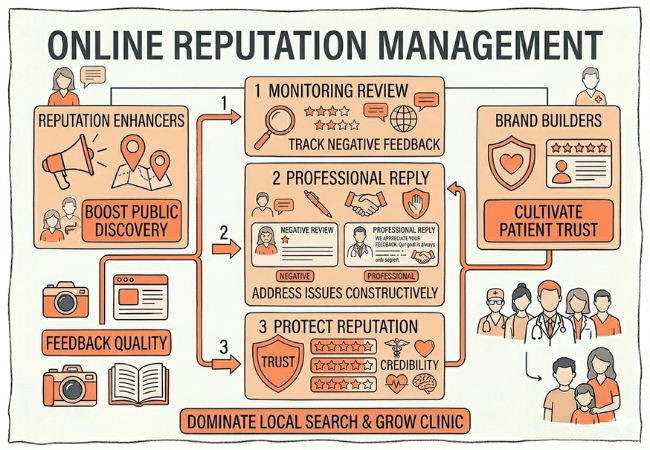
Negative reviews should not be ignored.
A good response should be:
Example:
“Thank you for sharing your feedback. We are sorry to hear about your experience. Patient care and communication are important to us. Please contact our clinic team directly so we can understand your concern and address it appropriately.”
Never reveal diagnosis, treatment, visit details, billing details, or personal health information in a public review reply.
Many healthcare practices lose enquiries not because of weak marketing, but because of weak follow-up.
A patient may call and not get a response. A WhatsApp message may remain unanswered. A form enquiry may not be followed up. A receptionist may not know how to explain the next step.
Marketing strategy must include patient communication systems.
WhatsApp can be useful for appointment coordination, reminders, basic information, and patient support.
However, sensitive medical information should be handled carefully. Consent, access control, and data minimization are important. Avoid sharing confidential reports, diagnosis details, or personal health information in unmanaged channels unless proper systems and permissions are in place.
| Layer | Strategic Question | Examples |
|---|---|---|
| Trust | Why should patients believe us? | Doctor credentials, reviews, education, experience, facility, transparency. |
| Visibility | How will patients find us? | SEO, Google Business Profile, ads, YouTube, social media |
| Conversion | How will patients contact us? | Website CTA, WhatsApp, phone, booking form, landing pages |
| Retention | How will we continue engagement? | CRM, reminders, follow-up, review requests, newsletters |

Best Focus: Build doctor-led trust, rank for specialty and location searches, and use content and video to humanize the doctor.

Best Focus: Promote priority services, improve local search presence, and convert enquiries into appointments.

t Focus: Grow key departments, promote centers of excellence, track enquiry sources, and align marketing with operations.
Healthcare marketing should be measured beyond likes and impressions.
Useful metrics include:
| Metric | Why It Matters |
|---|---|
| Organic traffic | Shows SEO growth |
| Keyword rankings | Shows search visibility |
| Google Business Profile views | Shows local discovery |
| Calls | Shows patient intent |
| WhatsApp enquiries | Shows lead generation |
| Appointment bookings | Shows conversion |
| Cost per lead | Shows ad efficiency |
| Cost per appointment | Shows business impact |
| Review count and rating | Shows reputation strength |
| Page conversion rate | Shows website effectiveness |
| Video views and retention | Shows patient education impact |
| Service-wise enquiries | Shows which departments are growing |
Mistake 1: Running Ads Without a Trustworthy Landing Page
Ads can bring traffic. But if the landing page does not explain the doctor, treatment, process, risks, cost, and appointment steps clearly, patients may not convert.
Mistake 2: Posting on Social Media Without Strategy
Random festival posts, generic health tips, and copied medical content rarely build authority.
Mistake 3: Ignoring Google Business Profile
For local healthcare, this can be a major missed opportunity.
Mistake 4: Writing Thin Service Pages
A 300-word page cannot fully answer patient questions or build authority. Generic content does not build authority. For healthcare, content must be specific, medically accurate, location-aware, and patient-focused.
Mistake 5: Ignoring Reviews
Reviews are one of the strongest decision-making factors for patients. A healthcare marketing strategy without review generation and review response is incomplete.
Mistake 6: Not Tracking Leads Properly
Many hospitals and clinics do not know:
Without tracking, marketing becomes guesswork.
Mistake 7: Poor Front-Desk Follow-Up
Marketing can generate enquiries, but the front desk converts them. If calls are missed, WhatsApp replies are delayed, or the patient is not guided properly, campaign performance will suffer.
Mistake 8: Ignoring Compliance
Unapproved patient images, exaggerated claims, weak consent, and careless data handling can create reputation and legal risk.
Ethics is not optional in healthcare marketing. It is the foundation.
Healthcare marketing must respect the patient’s vulnerability, privacy, dignity, and right to make informed choices.
The National Medical Commission’s professional conduct regulations govern standards of professional conduct for registered medical practitioners in India. Healthcare marketing should therefore be planned with awareness of medical ethics and restrictions around solicitation, misleading claims, endorsements, and professional dignity.
Ethical healthcare marketing builds long-term trust. Unethical marketing may generate short-term enquiries, but it damages reputation and patient confidence.
India’s Digital Personal Data Protection Act, 2023 provides a framework for processing digital personal data in a way that recognizes individuals’ right to protect their personal data while allowing lawful processing.
For healthcare marketing, this matters because clinics and hospitals often collect personal data through:
Website forms, Landing pages, WhatsApp enquiries, Appointment booking forms, Call tracking, CRM systems, Email campaigns, Patient feedback forms, Online payment links, Chatbots, Health camp registrations
For Indian doctors, clinics, and hospitals, DPDP-aware marketing is becoming increasingly important because healthcare enquiries often contain sensitive personal and health-related information.
HIPAA is a United States healthcare privacy law. It applies to covered entities and business associates as defined under HIPAA rules. HHS states that HIPAA Rules apply to covered entities and business associates, and business associates may need written assurances or agreements to safeguard protected health information.
For Indian healthcare providers, HIPAA may not apply in every situation. But it becomes relevant if the healthcare organization serves US patients, works with US healthcare entities, handles protected health information on behalf of US covered entities, or signs HIPAA-related agreements.
Even where HIPAA does not legally apply, HIPAA-style privacy thinking can improve trust and reduce risk.
Healthcare marketing teams must be careful with patient data.
Common risk areas include:
A healthcare marketing strategy should define what data is collected, where it is stored, who can access it, how long it is retained, and how it is protected.
Healthcare marketing strategy is a structured plan to help doctors, clinics, hospitals, and healthcare businesses attract the right patients, build trust, improve visibility, educate patients, and generate enquiries ethically.
Healthcare marketing strategy must consider patient trust, medical ethics, clinical accuracy, consent, privacy, and compliance.
Unlike general marketing, healthcare marketing cannot rely on aggressive claims, fear-based messaging, guaranteed outcomes, or casual use of customer stories. Patients are often anxious, vulnerable, and looking for reliable guidance before making a decision.
A healthcare marketing strategy should include positioning, patient journey mapping, website planning, SEO, content, Google Business Profile, video, social media, paid ads, reputation management, CRM, analytics, compliance, and patient data privacy.
The goal is to connect all marketing activities into one clear system that builds trust, visibility, and qualified patient enquiries.
The most important part is trust.
Patients need to believe that the doctor, clinic, or hospital is credible, experienced, ethical, and capable of helping them. Search visibility, ads, content, and social media can bring attention, but trust is what helps patients take the next step.
For individual doctors, the strategy usually focuses on personal authority, doctor profile visibility, educational content, and patient trust.
For clinics, the focus is usually on service-line growth, local SEO, reviews, paid campaigns, and enquiry conversion.
For hospitals, the strategy needs to be more department-wise, with doctor profiles, centres of excellence, patient journey mapping, call tracking, CRM, and reputation management.
Start by identifying services that have strong patient demand, clear search intent, good revenue potential, strong doctor expertise, and enough operational capacity. Not every service should be promoted equally. A good healthcare marketing strategy prioritizes services where patient need, business goals, clinical strength, and market opportunity overlap.
Yes.
A small clinic can start with a strong Google Business Profile, a clear website, focused service pages, ethical review collection, local SEO, patient education content, and basic enquiry tracking.
The strategy should focus on the most important services, the local patient base, and the channels most likely to create trust and enquiries.
Healthcare marketing needs both. Branding builds long-term trust, authority, and recall.
Lead generation creates immediate patient enquiries.
A balanced strategy uses educational content, SEO, reviews, doctor videos, and reputation building for trust, while using Google Ads, landing pages, WhatsApp follow-up, and CRM systems for measurable enquiries and appointments.
Patient education is central to healthcare marketing.
When patients understand their symptoms, treatment options, risks, recovery, cost factors, and when to consult a doctor, they make more informed decisions. Educational content also helps build trust, improve search visibility, and reduce repeated basic questions during enquiry calls.
Success should be measured using both marketing and business metrics.
Useful metrics include website traffic, search visibility, Google Business Profile calls, appointment enquiries, cost per lead, enquiry quality, appointment bookings, consultation show-up rate, treatment conversion, patient reviews, and revenue by service line.
Lead numbers alone are not enough. The real measure is whether marketing is bringing the right patients into the right care pathway.
It depends on the channels used.
Paid ads can generate enquiries faster if the landing page and follow-up system are strong. SEO, content, Google Business Profile, YouTube, and reputation-building usually take longer but create more sustainable visibility and trust over time.
A good strategy usually combines short-term lead generation with long-term authority building.
Common mistakes include running ads without a strong landing page, creating generic content, ignoring Google Business Profile, using weak doctor profiles, not tracking enquiries, overusing “best” claims, neglecting reviews, poor front desk follow-up, and ignoring privacy or consent.
Most failures happen because marketing activities are not connected to a clear patient journey.
A healthcare marketing strategy should be reviewed at least every quarter.
Review what is working, which services are generating quality enquiries, which pages are ranking, which ads are converting, what patients are asking, how reviews are improving, and where follow-up is weak.
Healthcare marketing should evolve based on patient behavior, competition, service priorities, and performance data.
Compliance is very important.
Healthcare marketing must consider medical ethics, patient consent, advertising guidelines, privacy policies, DPDP Act requirements in India, HIPAA where applicable, platform ad policies, and responsible handling of patient data.
A strong strategy should protect both the patient and the healthcare brand.
If your healthcare marketing feels scattered across website work, SEO, ads, social media, Google reviews, and WhatsApp follow-up, HappiMed can help you bring everything into one clear growth strategy.
We help doctors, clinics, hospitals, and healthcare businesses build practical marketing systems that improve visibility, patient trust, and enquiry generation.